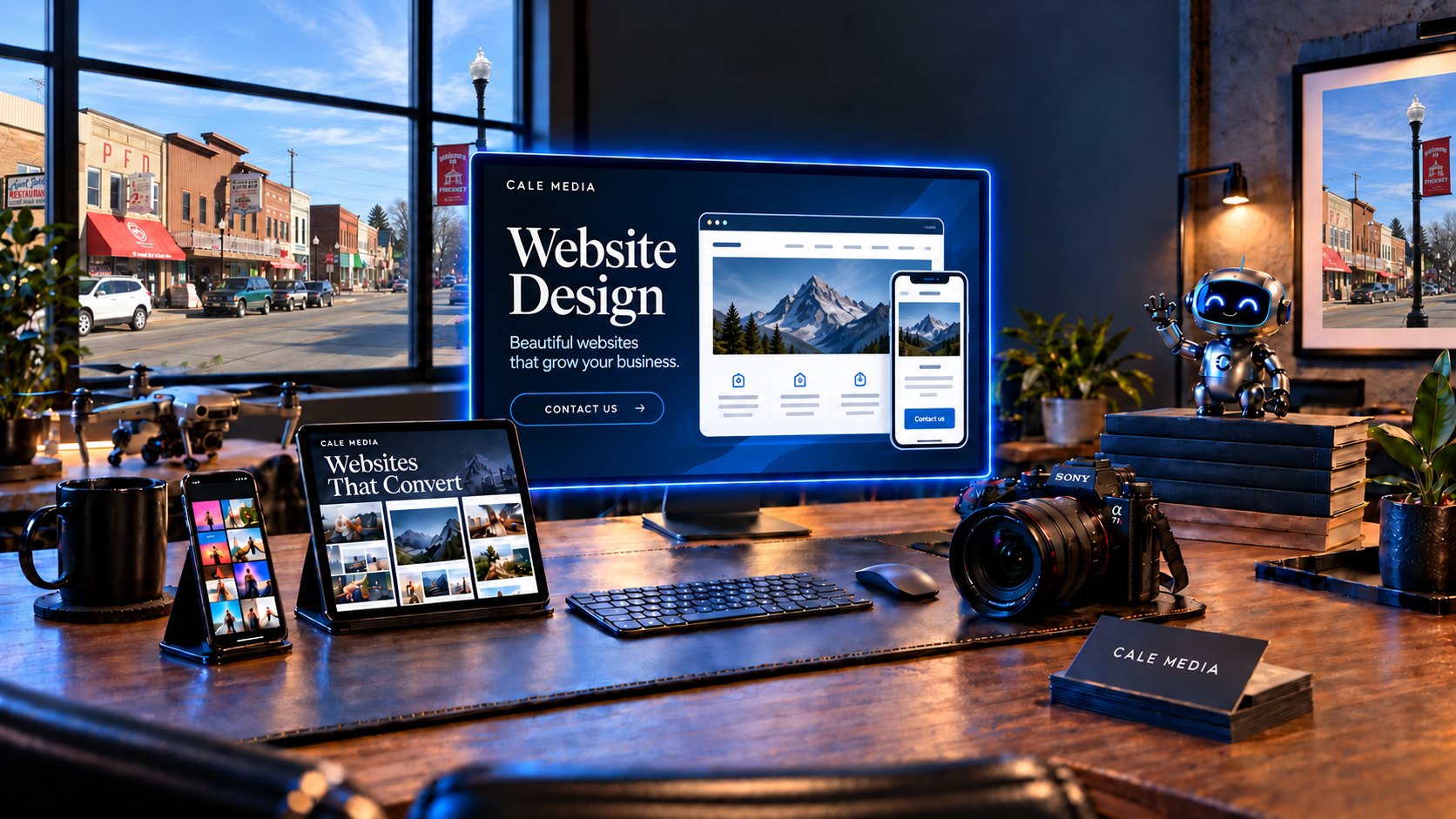
Website Design in Pinckney, MI
Clear service pages. Useful inquiries. A site built around your work.
SERVING PINCKNEY, MICHIGAN
Ownership and handoff matter before launch
A website you can’t update becomes a problem as soon as your services change. I build and improve websites for Pinckney businesses with the pages, account ownership and editing responsibilities agreed upfront. We plan what you can change yourself and where you’ll want help after launch.
THE DESIGN IS ONLY PART OF THE PURCHASE
Know what you are buying before the project starts
A business website is not one picture of a homepage. It is the domain, hosting, pages, words, photos, forms, analytics and the ability to change those pieces later. A proposal should say who handles each part and who controls it when the project is over.
Your accounts should stay yours
The domain, hosting, business email, analytics and Google access should not become mystery accounts that disappear with the designer. We write down what the business controls and what Cale Media is managing.
Pages and features need names
“A five-page website” says very little. The scope should identify the actual service pages, forms, galleries, integrations and content work so both sides know what is included.
Launch is not the last question
You need to know who updates hours, adds a new service, fixes a broken form and keeps the software current. That plan can be ongoing help or a clean handoff, but it should not be a surprise.
BUILT AROUND THE CUSTOMER ROUTE
A Pinckney customer should reach the right answer quickly
Someone who lands on the site from Google may not know the company yet. The page has to confirm the service, explain the fit, show useful proof and make the next action obvious on a phone. We keep the service explanation and contact options readable while any animation plays.
A search result or shared link reaches the most useful page.
The service, coverage and conditions are clear.
Real photos, reviews and explanations support the choice.
The visitor can call, contact or visit without hunting.
This path changes by business. A contractor may need service-area pages and a fast quote route. A restaurant may need hours, location, menu information and a reason to visit. The structure should follow how customers buy, not a template sold to every company.
WHAT CALE MEDIA CAN HANDLE
Words, layout, local search and launch checks in one project
A new design should solve a verified problem. I start by looking at the current site, the services the business wants more of and what a customer sees from search to contact. Then we decide whether the right job is focused improvement or a rebuild.
- Current-site review: record useful pages, URLs, links, forms and search signals before replacing anything.
- Page plan: organize services and locations around genuine customer decisions rather than forcing the whole company onto one homepage.
- Copy and visual direction: explain the work in plain language and identify the real photos, video, diagrams or proof needed to support it.
- Responsive build: create layouts that fit phones and larger screens without sideways scrolling, tiny controls or important copy hidden inside effects.
- Local SEO connection: use clear headings, titles, descriptions, internal links and page structure that support the services and areas the business actually serves.
- Launch verification: check key URLs, phone links, forms, metadata and the pages customers are expected to use.
Cale Media is based in Howell and serves Pinckney businesses.
If your work takes you beyond the village into Putnam Township or Hamburg, the website needs to explain which customers you can serve and any travel limits. If customers come to your premises, it needs your actual location, hours and useful arrival details. Those are different website jobs, even when both businesses appear in a Pinckney search. We plan the pages around how your business operates. The Pinckney local SEO page explains how the website and Google Business Profile should support the same honest service area.
PUT THE AGREEMENT IN WRITING
Questions a website proposal should answer
| Decision | What should be clear | Why it matters |
|---|---|---|
| Domain and hosting | Who owns the accounts, pays renewals and has administrator access | The business should not lose its address or site because one vendor disappears |
| Pages and content | Which pages, words, photos, forms and features are included | A page count alone does not define the finished job |
| Old website | Which useful URLs stay, move or redirect | A redesign should not casually erase working links and search history |
| After launch | Who handles updates, security, backups and future changes | The real cost continues after the new site appears |
| Measurement | Which calls, forms or other actions can be tracked | A prettier homepage is not proof that the website produces better inquiries |
AFTER THE WEBSITE GOES LIVE
A support plan should name the work you can ask for
Changing a service description and recovering a broken website are very different jobs. If both are buried under “website support,” you won’t know what your monthly payment covers or who to call when something stops working. I separate those responsibilities while planning a Pinckney website project, so you know how to get the site changed or repaired.
Keep the offer accurate
Hours, services, prices, photos and coverage. Agree who supplies the change, who approves it and who publishes it.
Keep the setup maintained
Software updates, backups and agreed checks. Name the responsible person and the schedule instead of assuming hosting covers everything.
Find what stopped working
A failed form, unavailable page or broken booking link needs diagnosis. Define where to report it and how repair work is authorized.
Choose the handoff around changes you actually make
If you regularly change a menu, availability or seasonal service, those edits should be straightforward. I can plan editable sections and show you the agreed tasks, or include help with changes in the project scope. A rarely changed capability page may need a different arrangement. You shouldn’t have to rebuild a page to correct a phone number.
For a hypothetical business serving Pinckney and nearby communities, adding Hamburg to the service area could affect the service page, inquiry wording and travel conditions. That’s a content change to review together. It doesn’t automatically mean creating another city page. A request to add online payments, by comparison, needs its own feature scope and any outside account costs identified first.
Make the repair route clear before you need it
The handoff should identify where problems are reported, what information helps reproduce them and when you can expect an initial response under the agreed arrangement. A response time is different from a guaranteed repair time. Some problems depend on the host, domain provider or a separate booking platform.
Backups also need a named owner and a recovery plan. Agree what is backed up, where it is kept and how restoration will be checked. Don’t treat the word “backup” on a proposal as proof that a complete recovery has been tested.
Send the current site and the changes you usually need. I’ll put the editing, maintenance and support responsibilities alongside the build scope, with separate work clearly identified before you commit. Contact us to plan the website and its handoff.
A PRACTICAL START
Bring the current site or the business plan
If you already have a website, send the address and explain what is not working. If the business is starting fresh, tell me what you sell, where you work and what a qualified inquiry looks like. I will separate the must-have work from ideas that can wait and put the recommended scope in writing.
- Review the starting point. Look at the current site, accounts, customer route and local search connection.
- Choose the job. Decide whether to improve the existing site or rebuild with a clear reason.
- Agree on ownership and scope. Name the pages, content, features, accounts and responsibilities.
- Build and review. Check the words, layout and actions on the screens customers use.
- Launch and verify. Test the live URLs, links, forms and agreed tracking before treating the project as complete.
CONTACT CALE MEDIA
Tell me what the website needs to do
Send the current site if you have one and tell me which services or products matter most. We can talk about fixing what is weak, rebuilding when it makes sense, and what you should control after launch.
Useful details to include
- Your current website
- The work you want more of
- Your real service area
- The biggest problem on mobile
- Accounts you already control